
A Love Letter to Beef, Smoke, and Questionable Time Management
There are recipes you make because you’re hungry.
There are recipes you make because you want to try something new.
And then there are recipes that require you to carefully select a 16-pound slab of beef, season it the night before, fill a smoker with pecan wood, go to sleep while it cooks, wake up and check on it, go to work, come home, change temperatures, switch to hickory, wait another four hours, rest it until midnight…
…and then turn the damn thing into nigiri.
Welcome back to This Month’s Recipe at Sushi Win Jr. in Evergreen, Colorado.
Longtime customers already know something about me:
I am a dirty slut for red meat.
There. It’s officially on the internet now.
I wear my “King of the Grill” apron around the restaurant almost every day, and brisket has always held a special place in my heart. There’s something beautiful about taking a huge, stubborn, intimidating piece of beef and transforming it through nothing more than seasoning, smoke, heat, moisture, and an almost unreasonable amount of patience.
And because apparently making sushi all day isn’t enough of a culinary hobby for me, I decided I wanted to develop my own 24-hour smoked brisket recipe.
Not 8 hours.
Not 12.
Twenty-four. Freaking. Hours.
And yes, it is worth it.
Good Things Come to Those Who Smoke Meat for an Entire Day
Let me get something out of the way before we start.
This is not a quick recipe.
If you’re looking for “Easy 30-Minute Weeknight Brisket,” I have some unfortunate news about brisket.
This cook is a commitment.
But that commitment is precisely what makes it special. I’ve spent years learning that some of the best flavors cannot be rushed. Whether I’m developing a new sushi roll at Sushi Win Jr., experimenting with sauces, playing with textures, studying ingredients, or standing outside staring lovingly at a smoker like a concerned father…
time is an ingredient.
For this recipe, I wanted maximum smoke exposure, a strong bark, a beautiful smoke ring, rendered fat and incredibly tender beef that still retained enough structure to pass the finger test.
I didn’t want mush.
I wanted that beautiful moment where a slice bends over your finger, holding together over its own weight, and then gives way with almost no resistance when you bite into it.
That meant giving the brisket the best possible chance of surviving 24 hours of smoke.
And that starts before we even get home.
Step One: Choosing the Brisket
Our story begins beneath the romantic fluorescent lights of the meat department.
And yes, I am that guy digging through the briskets.
Sorry.
If I’m spending an entire day cooking something, I’m not grabbing the first brisket I see and hoping Jesus takes the wheel.
I’m picky.
For this method, I’ve found my sweet spot to be a whole packer brisket slightly over 16 pounds.
Smaller briskets certainly work, and they’ll cook faster, but personally I feel like they don’t get the same prolonged exposure to smoke that I’m chasing with this recipe. On the opposite end, I’ve played with the monsters pushing 20 pounds, and I find those more difficult to cook evenly.
Around 16 pounds?
That’s my Goldilocks brisket.
Not too big. Not too small. Just enough cow.
What I’m looking for:
A thick brisket with a relatively uniform shape
Plenty of visible intramuscular marbling
A thick, healthy point
A flat that isn’t ridiculously thin
An even fat cap
Preferably at least an inch of fat in areas where I might otherwise need room for trimming
Why all the marbling?
Because we’re about to ask this poor thing to spend an entire day in a smoker.
Fat is flavor, but during an exceptionally long cook, it also gives us some insurance.
And here comes another unusual part of my recipe:
I don’t trim this brisket.
Yep.
Team No-Trim.
For this particular low-and-slow method, I leave the fat cap and brisket intact. With the incredibly long cooking time, I want that protection and rendered fat working in my favor.
Could you trim yours?
Absolutely.
This is barbecue, not a dictatorship.
Step Two: The Overnight Dry Brine
My brisket journey begins at approximately 9:00 PM the night before the smoke.
First, I coat the entire brisket with yellow mustard.
Before somebody starts typing an angry barbecue comment: relax.
The mustard is primarily acting as a binder, helping our seasoning stick evenly across that enormous piece of beef.
Then comes the seasoning.
The essentials:
Himalayan pink salt and coarse-ground black pepper.
Honestly, that’s enough.
Good beef + salt + pepper + smoke will take you incredibly far.
But because leaving perfectly good things alone has apparently never been one of my strengths, I also like adding a very small amount of cumin, onion powder and garlic powder.
Emphasis on small.
I don’t want the seasoning screaming over the beef. I want those flavors sitting quietly in the background, adding a little complexity while beef, salt, pepper and smoke remain the stars.
Once seasoned, place the brisket into a large aluminum tray, cover it and let it dry brine overnight in the refrigerator.
Now we wait.
Our first exercise in patience.
10:00 PM (Following Day)— LIGHT THE FIRES
For this recipe, I’m using my Pit Boss Austin XL pellet smoker.
Temperature:
180°F
And my first fuel of choice?
Pecan pellets.
Pecan gives me a beautiful smoke character without immediately overwhelming the meat. Because this brisket will be exposed to smoke for an extraordinarily long time, I’m thinking about smoke almost like seasoning.
I don’t want one note hammering the palate for 24 straight hours.
We’re building layers.
But before the brisket goes anywhere near the smoker, there’s one little trick that I consider incredibly important to this recipe.
The Water Pan
On the bottom rack of the smoker, I place a large pan approximately halfway filled with boiling water.
Then the brisket goes onto the rack above it.
Why boiling water?
I don’t want to make the smoker waste energy bringing a pan of cold water up to temperature. We’re starting hot and introducing moisture immediately.
For placement, I cook the brisket:
Fat cap UP.
The thicker point goes toward the primary heat source, while the leaner flat stays farther away from that heat.
Remember, our goal isn’t simply to cook the brisket.
We’re trying to cook it evenly.
Insert a reliable meat thermometer into the thickest portion of the meat. Make sure the tip is sitting inside the muscle rather than buried inside a giant pocket of fat, otherwise you’re not getting the reading you think you’re getting.
Water pan underneath.
Pecan smoke rolling.
Brisket positioned.
Thermometer inserted.
180°F.
Close the lid.
And now comes my favorite barbecue technique:
Go to bed.
7:00 AM — GOOD MORNING, BEAUTIFUL
Few things will get me out of bed faster than knowing there is approximately 16 pounds of smoked beef waiting outside.
At around 7:00 AM, I open the smoker.
Now we’re looking for the beginning of our bark.
The exterior should be darkening. The seasoning has bonded with the surface. Smoke has been slowly working its way across that brisket throughout the night.
My internal temperature around this stage is usually somewhere in the 160°F range.
Now we make our first adjustment.
I increase the smoker from:
180°F → 200°F
I refill the water pan with more hot water.
And now it’s time for our second wood.
Hickory.
The pecan handled the first half of the smoke.
Hickory gets the second.
Pecan brings a slightly sweeter, nuttier smoke character. Hickory comes in with that deeper, stronger, unmistakable barbecue personality.
Again:
layers.
I’m not looking for smoke that punches you in the mouth.
I’m looking for smoke that makes you take another bite because you’re trying to figure out everything you’re tasting.
I fill the hopper with hickory pellets.
Close the lid.
And…
I go to work.
Yes, my brisket has a work schedule.
The Part Where We Ignore Traditional Barbecue Advice
Normally, somewhere around this stage, you’ll see people reaching for butcher paper.
Or aluminum foil.
Or making a foil boat.
Those are all legitimate techniques.
They help manage the stall, retain moisture and accelerate the cook.
I decided to do none of them.
No butcher paper. No foil wrap. No foil boat.
Why?
Because if I’m committing to a 24-hour smoked brisket, I want that beef exposed to smoke for the entire journey.
I wanted to see what happened when I allowed the bark to continue developing naturally while using the water pan and fat cap to help protect the meat.
Could it backfire?
Sure.
That’s what makes experimenting fun.
Culinary development would be incredibly boring if every chef simply copied what the restaurant down the street was doing, changed two ingredients, gave it a different name and called it innovation.
I’ve never wanted Sushi Win Jr. to be that restaurant.
I want to experiment.
I want to learn.
I want to screw things up occasionally.
I want to figure out why something works.
And when I finally get it right?
I want to share it.
Hell, I’ll even give you the recipe.
Competitors, you’re welcome.
Now make something cool with it.
6:00 PM — WE’RE APPROACHING THE FINISH LINE
After another day bathing in smoke, my brisket is usually sitting around:
175°F internal
We’ve entered the final push.
This is where I increase the Pit Boss one more time:
200°F → 225°F
We’ve spent approximately 20 hours patiently building smoke and bark.
Now I’m ready to finish.
The higher temperature helps us push through the stubborn final portion of the cook while continuing to develop that exterior.
Four more hours.
And yes, by this point, your entire property smells ridiculous.
Neighbors may suddenly become unusually friendly.
10:00 PM — 24 HOURS LATER
This is where people get themselves into trouble.
They see a recipe that says:
198°F
…and assume 198°F automatically means the brisket is finished.
No.
For my cook, the brisket reached approximately 198°F internal around 10:00 PM.
But barbecue does not own a watch.
Your brisket doesn’t know what my brisket did.
A 16-pound brisket from one animal may behave differently from another 16-pound brisket. Fat distribution, thickness, smoker behavior, weather, ambient temperature and about a million other tiny variables can affect the cook.
Temperature is your roadmap. Tenderness is your destination.
Once you’re approaching the upper 190s, start checking the meat with your temperature probe.
Push it into different areas of the brisket.
You’re looking for probe tender.
Very little resistance.
People often describe it as pushing the probe into softened butter.
That’s far more important than obsessing over whether your display says exactly 198°F, 200°F, 203°F or whatever magic number the internet told you.
Cook the brisket in front of you.
Not mine.
And Now We Rest
Once I’m happy with the tenderness, I pull the brisket and place it into a fresh aluminum tray.
Then I loosely tent the top with aluminum foil.
Don’t suffocate it.
After spending an entire day developing that gorgeous bark, I don’t want trapped steam immediately undoing our work.
And now comes perhaps the cruelest part of barbecue:
Don’t eat it yet.
I recommend giving the brisket at least two hours to rest.
The meat has just spent 24 hours getting absolutely assaulted by heat and smoke.
Give her a minute.
For my schedule, that meant my brisket came off around 10:00 PM and was finally ready around:
Midnight.
Is midnight an objectively stupid time to finish dinner?
Probably.
Did I care once I sliced into it?
Absolutely not.
The Moment of Truth
Knife through the flat.
Beautiful bark.
Smoke ring staring back at me.
Juices.
Rendered fat.
Then the finger test.
I laid a slice across my finger and watched it bend while maintaining its structure.
Perfect.
Take a bite?
Tender enough to pull apart effortlessly without having turned into shredded beef.
Exactly what I wanted.
Then came the flavor.
The pecan and hickory combination was absolutely beautiful.
The pecan gave me that softer, slightly sweet smoke character I wanted early in the cook, while the hickory brought the deeper barbecue flavor later.
Twenty-four hours of smoke.
No wrap.
No shortcut.
Just beef, seasoning, moisture, wood, heat and patience.
Pure freaking perfection.
And naturally…
I couldn’t leave it alone.
So I Turned the Brisket Into Sushi
This is where the Sushi Win Jr. part of the story enters the room.
I could have sliced the brisket, put it on a tray, poured myself a drink and called the experiment successful.
But where’s the fun in that?
I’m a sushi chef.
So staring at the point and flat gave me an idea.
The fatty, incredibly rich point reminded me of the characteristics I love when working with richer cuts of fish.
So I turned it into:
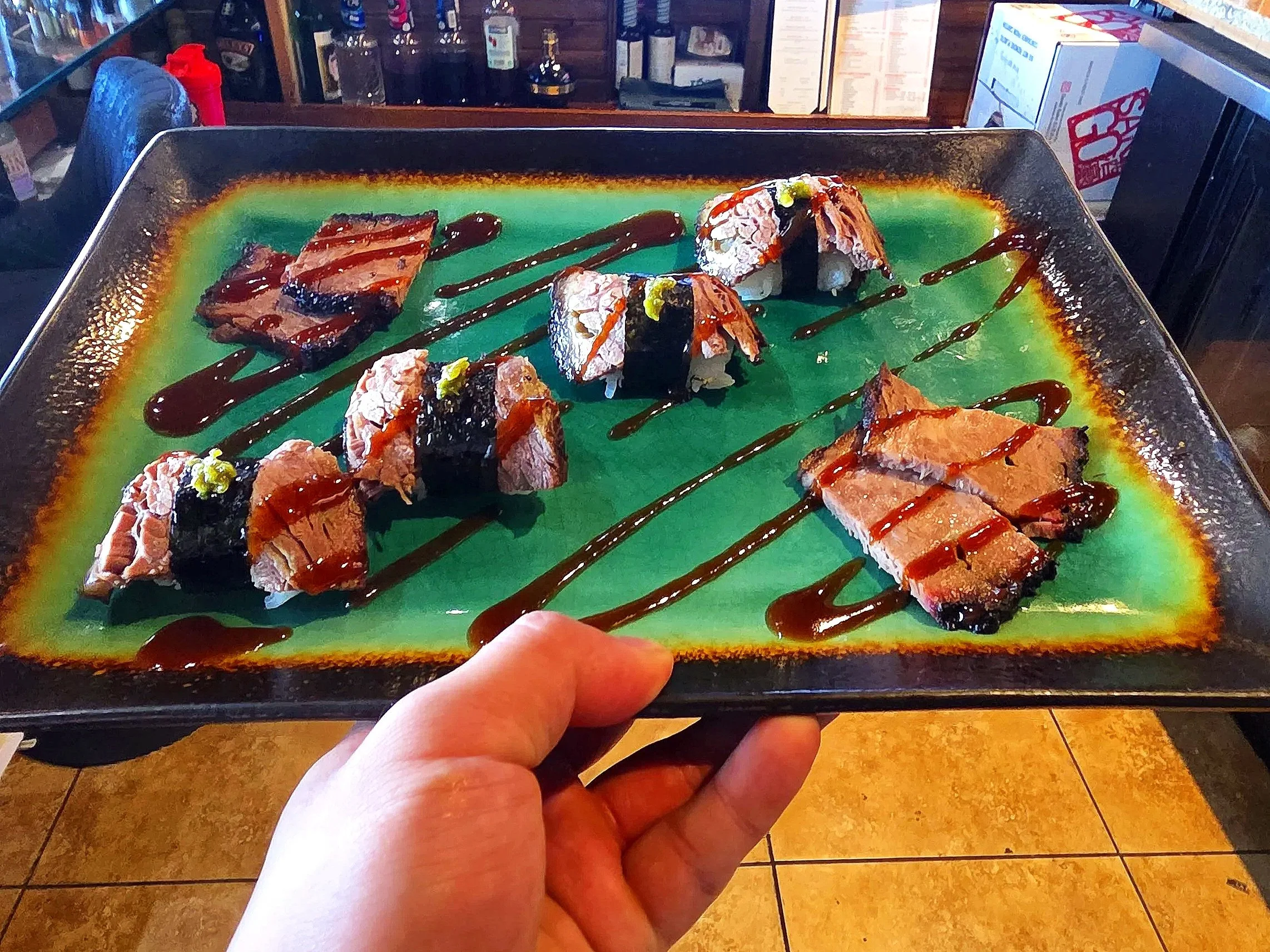
24-Hour Smoked Brisket Nigiri.
A small mound of seasoned sushi rice.
A slice of that rich smoked brisket point across the top.
Then I looked at the leaner, beautifully structured flat.
That became:
24-Hour Smoked Brisket Sashimi.
No rice.
Just beautiful slices of brisket presented with the same attention I’d give a sashimi plate.
But we weren’t done.
On top went a little jalapeño purée, bringing brightness and heat to cut through the richness of the beef.
Then came a drizzle of my roasted brown sugar BBQ sauce, adding sweetness and another roasted dimension against the smoke.
Fat.
Smoke.
Salt.
Sweetness.
Heat.
Acidity.
Tender beef.
Sticky sushi rice.
That little punch of jalapeño.
Absolutely. Freaking. Divine.
Why Would a Sushi Restaurant in Evergreen Make 24-Hour Brisket?
Because I can.
That’s the short answer.
The longer answer is that this is exactly what I want Sushi Win Jr. in Evergreen, Colorado to represent.
I love sushi.
I love Japanese cuisine.
I love barbecue.
I love steaks.
I love cocktails.
I love learning how different cultures and cuisines approach fat, salt, acid, smoke, fermentation, heat, texture and presentation.
And I don’t believe being a sushi chef means I have to stop being curious about everything else.
Quite the opposite.
Everything I learn outside of sushi eventually changes how I think about sushi.
That’s how new ideas happen.
When I took over Sushi Win Jr., I made a promise to myself that I wasn’t going to simply maintain what already existed.
I wanted to push it.
Try strange things.
Read.
Eat.
Study.
Experiment.
Fail occasionally.
Try again.
Make things customers haven’t seen at every other sushi restaurant.
And maybe push some other restaurants around me to experiment a little harder, too.
Competition should make food better.
If somebody sees this brisket and thinks, Son of a bitch, now I have to step up my game…
GOOD.
Please do.
Push me back.
That’s how all of us get better.
And the people who ultimately win are the customers getting increasingly ridiculous things to eat.
Want to Try My 24-Hour Brisket Schedule Yourself?
My original schedule was built around operating a restaurant, which explains why I was standing around eating brisket at midnight like some kind of barbecue goblin.
You don’t need to copy that.
If you’d prefer your brisket ready for a normal dinner, simply shift the entire process backward from when you’d like to eat.
For example, if you’re aiming for a 6:00 PM dinner, work backward approximately two hours for the rest and approximately 24 hours for the smoke. That puts your starting point around 4:00 PM the previous day, with your dry brine beginning earlier.
The exact schedule matters less than understanding the progression:
Dry brine → 180°F → establish bark → 200°F → finish at 225°F → probe tender → rest → feast.
And remember:
Do not cook exclusively by my clock.
Use my timeline as a reference, not a commandment.
Watch your internal temperature.
Watch your bark.
Keep your water pan from drying out.
Learn where your smoker’s hotter zones are.
And most importantly, feel the brisket with your probe before deciding it’s finished.
Every brisket is different.
That’s part of the fun.
The 24-Hour Smoked Brisket Cheat Sheet
Brisket: Whole packer, approximately 16+ pounds
Trim: None for my method
Binder: Yellow mustard
Primary seasoning: Himalayan pink salt + coarse black pepper
Optional seasoning: Small amounts of cumin, garlic powder + onion powder
Smoker: Pit Boss Austin XL pellet smoker
First wood: Pecan pellets
Second wood: Hickory pellets
Water pan: Yes — start approximately halfway full with boiling water
Position: Fat cap up; point toward hotter area, flat farther away
Starting smoker temperature: 180°F
Second stage: 200°F
Finishing stage: 225°F
Wrapping: None
Target finishing range: Upper 190s°F, but probe tenderness determines doneness
Rest: At least 2 hours
Total smoke: Approximately 24 hours
Recommended beverage while staring unnecessarily at the smoker: Dealer’s choice.
From My Smoker to Your Table
Food is supposed to be shared.
That’s really the reason I’m publishing recipes like this.
I’ve spent years cooking professionally, experimenting behind the scenes, reading cookbooks, studying techniques, eating other people’s food, developing my own recipes and learning from plenty of mistakes along the way.
I could keep all of that locked away.
But why?
If somebody in Evergreen reads this, buys a brisket this weekend, fires up their smoker and makes an incredible dinner for their family because of something I shared?
That’s freaking awesome.
If another chef reads it and steals an idea?
Go for it.
Just make it good.
Because I have plenty more where this came from.
That’s what pursuing excellence means to me. Not guarding every little idea like it’s the nuclear launch code.
It’s continuing to learn fast enough that by the time everyone catches up to what you did yesterday…
you’re already cooking tomorrow’s idea.
So fire up the smoker.
Buy an irresponsibly large piece of beef.
Invite some friends over.
Be patient.
And if you decide to put your brisket on sushi rice afterward?
Well…
now you’re speaking my language.
Your friendly neighborhood Sushi Cowboy,
Ryan @ Sushi Win Jr. 🍣🔥❤️